







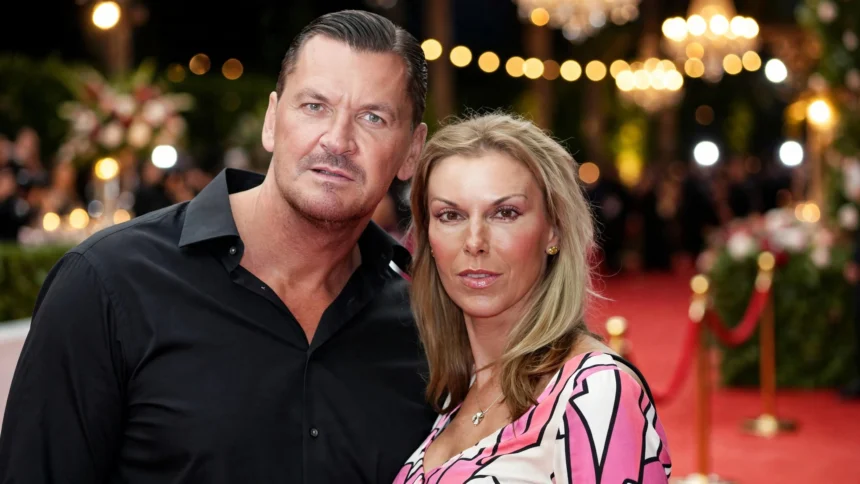
Elke Kellick is a former model whose story sits at an interesting intersection of 1980s British popular culture, celebrity family life, and deliberate privacy. Although her name has remained connected with actor Craig Fairbrass for decades, her own public profile has been comparatively limited. Available biographical sources consistently describe her as a former Page Three model and report that she married Fairbrass in 1987.
Rather than following the familiar path of celebrity spouses who remain permanently visible, Kellick appears to have chosen a quieter existence. Consequently, much of what is written about her today comes from brief biographical references rather than extensive interviews or first-person accounts.
A Brief Biography at a Glance
| DetailInformation | |
| Name | Elke Kellick |
| Known for | Former model |
| Modelling background | Associated with Page Three modelling |
| Spouse | Craig Fairbrass |
| Marriage | 1987 |
| Children | Two sons |
| Public profile | Relatively private |
Because detailed primary-source material about Kellick is scarce, some personal information frequently repeated online should be treated cautiously. In particular, claims about her exact age, education, later occupations, or other private circumstances are not consistently supported by strong sources.
The Modelling Era That Shaped Her Public Identity
Kellick’s early public identity is closely associated with British modelling culture of the 1980s. During that period, Page Three was a prominent feature of tabloid publishing, and the models appearing in the feature could become recognisable names within popular culture.
For Kellick, modelling provided a public identity before her connection with the acting world became central to how many people encountered her name. However, the available record does not provide enough detail to construct a complete chronology of her modelling career.
That gap is significant. Modern celebrity biographies often document careers through interviews, social media, agency records, and continuous publicity. By contrast, many figures from earlier media eras left behind much smaller public archives.
Marriage to Craig Fairbrass
One of the clearest documented elements of Kellick’s biography is her marriage to English actor Craig Fairbrass. Public biographical sources state that the couple married in 1987 and have two sons.
Fairbrass went on to develop a substantial career in British television and international film. His credits include EastEnders, Cliffhanger, The Bank Job, and other screen projects, while he has also been associated with video-game voice work.
The contrast between the two careers is particularly interesting. While Fairbrass remained professionally visible, Kellick did not establish a similarly prominent public career.
A Family Life Away From Constant Publicity
The relationship between a public actor and a private partner can create an unusual form of celebrity visibility. A person may become recognisable because of a famous spouse while simultaneously having very little direct media presence.
That appears relevant to Kellick’s story. Her name is frequently mentioned in connection with Fairbrass, yet there is comparatively little first-person material in which she discusses her own experiences.
This distinction matters because being connected to celebrity is not necessarily the same as actively seeking celebrity. In an era when social media encourages public figures to share everyday experiences, Kellick’s much quieter profile belongs to a different media culture.
The Changing Meaning of Privacy
The story also offers a useful perspective on how celebrity has changed.
During the 1980s and 1990s, public recognition was largely controlled by newspapers, magazines, television, and entertainment photographers. A person could attract attention through one aspect of life and then retreat from public view.
Today, maintaining that separation can be considerably more difficult. Public figures and their families can encounter constant online discussion, archived photographs, social platforms, and rapidly reproduced biographies.
Against that background, Kellick’s relatively limited public presence becomes part of the story itself. Her absence from the media is not simply a missing detail; it illustrates an older model of celebrity boundaries.
Public Interest Without a Public Persona
There is an intriguing paradox surrounding Kellick. People continue to search for information about her precisely because there is comparatively little information available.
Her name connects several areas of cultural interest: British modelling history, entertainment families, celebrity marriage, and changing attitudes toward privacy. Yet those subjects should not encourage speculation about details that have never been reliably documented.
For example, some online biographies provide highly specific claims about her background. However, recent publications themselves acknowledge that information such as her exact age and certain aspects of her career remain difficult to verify.
A responsible profile therefore needs to distinguish established information from repeated online claims.
The Broader Cultural Context of Page Three
Understanding Kellick’s early career also requires understanding the media environment in which Page Three existed.
The feature became a significant part of British tabloid culture, particularly during the latter decades of the twentieth century. Its models occupied a distinctive place in popular publishing, where glamour photography, celebrity culture, and newspaper readership overlapped.
Consequently, a model associated with Page Three could become publicly recognisable without becoming an actor, presenter, or recording artist.
Kellick’s connection to that era therefore provides a small window into a much broader cultural history. Her biography is not only about one individual; it also reflects a period when print media had enormous influence over how public personalities were created and remembered.
What Can Actually Be Confirmed?
One of the most important aspects of researching Kellick is recognising the limits of the available record.
The better-supported details are that she was a former Page Three model, married Craig Fairbrass in 1987, and has two sons with him. These points are repeated across biographical sources.
Other claims require more caution. Online articles sometimes present precise personal details without demonstrating where those details originated. When information concerns a private individual, repeating uncertain claims can easily turn speculation into apparent fact.
Therefore, the most credible approach is relatively simple: use documented information, identify uncertainty, and avoid filling gaps with assumptions.
Why Her Story Still Attracts Attention
The continuing interest in Kellick reflects a wider fascination with people who exist close to celebrity without becoming conventional celebrities themselves.
Her story contains several recognizable elements: an earlier modelling career, a long marriage to a working actor, family life connected to the entertainment world, and a decision to remain largely outside the public conversation.
Moreover, the limited nature of the available record encourages readers to think about what celebrity biographies often leave out. Public attention can tell us a great deal about someone’s professional activities while revealing very little about their everyday identity.
In that sense, privacy becomes an important part of the biography rather than an obstacle to it.
A Different Kind of Celebrity Story
Many celebrity profiles are built around visibility: appearances, interviews, awards, photographs, social media posts, and professional announcements. Kellick represents almost the opposite model.
Her connection to entertainment is clear, but her personal public record remains comparatively restrained. That difference provides a useful reminder that people connected to famous figures do not automatically owe the public a complete account of their lives.
At the same time, the ongoing interest in her demonstrates how celebrity culture can continue to follow someone even after they have stepped away from it.
Looking at the Record With Perspective
When examining a relatively private figure, restraint is just as important as detail.
Kellick’s biography can be outlined through her modelling background, marriage to Craig Fairbrass, and family life, but the available evidence does not justify inventing a more elaborate narrative. Recent profiles likewise emphasise that important aspects of her present life remain outside public knowledge.
That limitation should not make the story less interesting. Instead, it creates an opportunity to examine how biographies are constructed and how much of a person’s real life can remain beyond the reach of public documentation.
FAQs About Elke Kellick
Who is Elke Kellick?
Elke Kellick is a former model associated with the Page Three modelling culture of 1980s Britain. She later became known more widely through her marriage to actor Craig Fairbrass.
When did Elke Kellick marry Craig Fairbrass?
Public biographical sources state that Kellick and Craig Fairbrass married in 1987.
Does Elke Kellick have children?
Yes. Public biographies state that she and Fairbrass have two sons.
What was her career?
She is consistently described in available biographical sources as a former model, particularly in connection with Page Three during the 1980s.
Why is there limited information about her?
Unlike her husband, Kellick has maintained a comparatively private public profile. As a result, there are relatively few direct interviews or detailed first-person accounts available.
Is every detail about her online reliable?
No. Some websites publish highly specific personal information that is difficult to independently verify. It is therefore sensible to distinguish consistently documented facts from unsupported or repeated claims.
Conclusion
Elke Kellick’s story is ultimately less about celebrity spectacle than about the boundaries surrounding it. Her modelling career placed her within an important chapter of British popular culture, while her marriage to Craig Fairbrass connected her to a long-running acting career. Yet she did not maintain the same level of public visibility.
That contrast makes her biography distinctive. In an age when personal lives can become increasingly public, Kellick’s relatively quiet profile demonstrates that proximity to fame does not necessarily require permanent participation in it.
The most meaningful lesson may therefore be found in what the public record does—and does not—contain. A biography does not become richer by filling every gap with speculation. Sometimes, the most responsible account is the one that recognizes the limits of what can genuinely be known.